
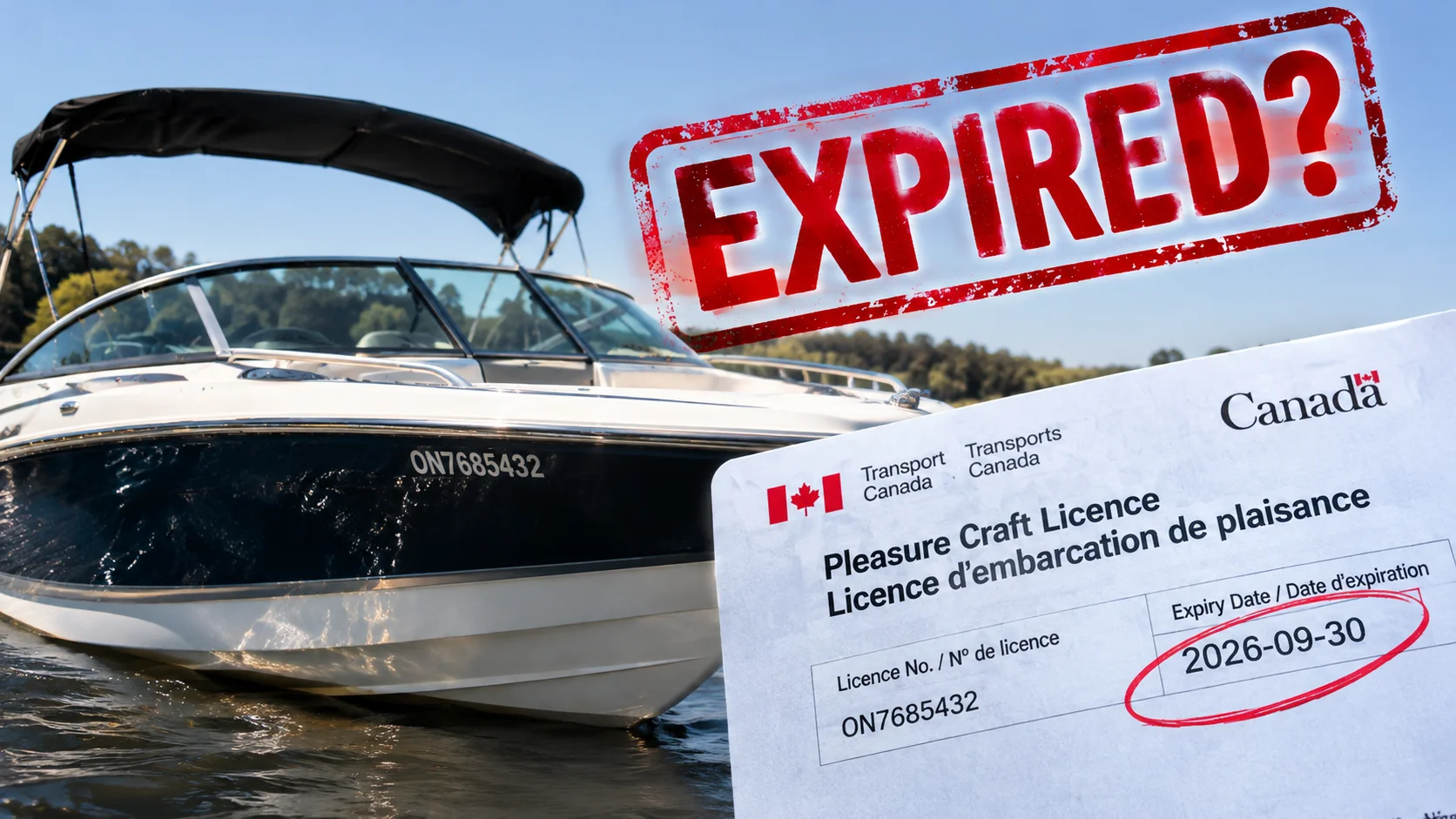
If your boat has been in the family for decades, there’s a good chance its Pleasure Craft Licence has never had an expiry date. That changed on December 31, 2025. Transport Canada’s amendments to the Small Vessel Regulations brought in five-year licences, a service fee and tighter deadlines for keeping owner information current. Older “lifetime” licences now expire on a set schedule, and the next wave of expiries lands on December 31, 2026, only a few weeks away.
With boats coming out of the water and going into storage across the country, late fall is a good time to sort this out. Here’s what changed, who’s affected, how to check and renew your licence, and what the new rules mean if you plan to buy or sell a boat.
The short version
New, renewed and transferred Pleasure Craft Licences (PCLs) are now valid for five years.
Old licences with no expiry date have been given one, based on when they were issued.
Licences issued between January 1, 1975 and December 31, 1985 expire on December 31, 2026.
There’s now a service fee (announced at $24 and adjusted for inflation every April 1) to issue, renew, transfer or replace a licence. Updating your information is free.
You must update your name, address and other licence details within 30 days of a change (it used to be 90).
A buyer must transfer the licence into their name within 30 days of the sale.
Your Pleasure Craft Operator Card (PCOC) is not affected.
What is a Pleasure Craft Licence, and who needs one?
A Pleasure Craft Licence is a document with a unique number that identifies your boat, a bit like a licence plate on a car. It isn’t proof of ownership. Its job is to help police and search and rescue crews quickly find out who owns a boat in an emergency, and to help authorities deal with wrecked or abandoned vessels.
According to Transport Canada, a pleasure craft used for recreation needs a licence if it meets both of these conditions:
it has one or more engines totalling at least 10 horsepower (7.5 kW), even temporarily, and
it’s principally operated and maintained in Canadian waters.
Boats that are registered in the Canadian Register of Vessels don’t need a PCL. Registration is a separate, more involved process, usually chosen by owners who want an official name for their boat, need to register a marine mortgage, or plan to cruise outside Canada.
The licence number must be displayed on both sides of the bow, and you should keep a copy of the licence on board. Transport Canada notes you may be fined $250 if your boat doesn’t have a valid licence.
Licence vs. operator card: not the same thing
People mix these up all the time. The PCL belongs to the boat. The Pleasure Craft Operator Card (PCOC) belongs to the person driving it, and proves you’ve passed a boating safety test. The 2025 changes apply to the boat licence only. If you already have a PCOC, nothing has changed for you there.
What changed on December 31, 2025
Transport Canada announced the changes in January 2026, noting that roughly 12 million Canadians go boating. The department says the goals are safer boating, better protection for the environment and fairer cost-sharing for running the licensing program. Accurate owner records also help authorities deal with wrecked, hazardous and abandoned vessels.
Topic | Before | Now |
|---|---|---|
How long a licence lasts | 10 years, or no expiry on older licences | 5 years for new, renewed and transferred licences |
Cost | Free | Service fee to issue, renew, transfer or replace (announced at $24, indexed to inflation) |
Updating your details | Within 90 days | Within 30 days, no fee |
Old lifetime licences | Valid indefinitely | Phased out on a fixed schedule |
Sailboats over 6 m with no engine | No licence needed | Licence required starting December 31, 2027 |
Fees are tied to inflation and can change every year on April 1, so check Transport Canada’s fees page for the current amount before you apply. People who use their boat to exercise Indigenous rights recognized under section 35 of the Constitution Act, 1982, such as hunting, fishing and trapping, don’t pay the fee. There’s a checkbox for that declaration on the application.
When does your old licence expire?
If your licence has no expiry date printed on it, Transport Canada has assigned one based on the date it was issued:
Licence issue date | New expiry date |
|---|---|
December 31, 1974 or earlier | March 31, 2026 (already expired) |
January 1, 1975 to December 31, 1985 | December 31, 2026 |
January 1, 1986 to December 31, 1995 | December 31, 2027 |
January 1, 1996 to December 31, 1999 | December 31, 2028 |
January 1, 2000 to December 31, 2005 | December 31, 2029 |
January 1, 2006 to April 28, 2010 | December 31, 2030 |
If your boat’s licence was issued before 1975, it expired on March 31, 2026. If that’s you, renew before next season.
Not sure when yours was issued? You can look up your licence’s expiry date with your PCL number on Transport Canada’s licence page.
How to renew your Pleasure Craft Licence
The good news is that renewing is quick and can be done online. Based on Transport Canada’s how to apply page, the steps are:
If you can’t apply online, you can still apply by mail with a money order payable to Pleasure Craft Licensing. Allow more time, and keep copies of everything you send. |
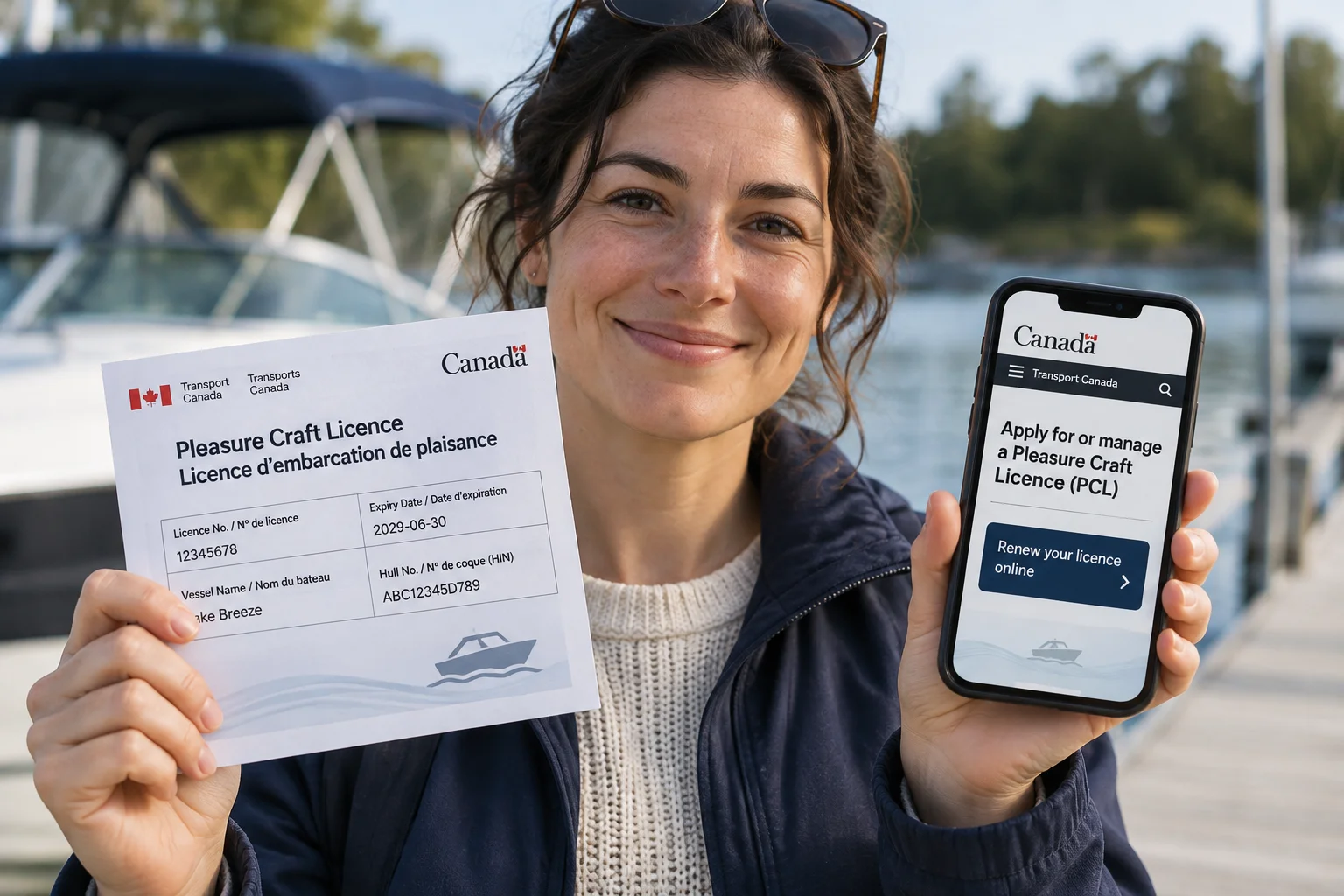
Check your expiry date. You can only renew within the three months before your licence expires. For a December 31, 2026 expiry, that window is already open.
Gather your documents. You’ll need a copy of valid government-issued ID for every owner. If someone else is applying for you, you’ll need a third-party authorization letter. If the boat is owned by a business, you’ll need authorization to apply for that legal entity.
Have a credit card ready. Online payments are by Visa or Mastercard.
Apply online. After you submit, Transport Canada emails you a temporary licence valid for 30 days, so you can keep using the boat right away.
Watch for your permanent licence. Transport Canada aims to issue it within five business days of receiving a complete application. Your new expiry date will be five years from the renewal date.
If you can’t apply online, you can still apply by mail with a money order payable to Pleasure Craft Licensing. Allow more time, and keep copies of everything you send.
Keep your information current
The new 30-day rule covers changes to your name, address, phone number, email address and the boat’s details, such as a new engine. Updates are free, but they don’t reset your expiry date. Moving to a new house this winter? Add your boat licence to the change-of-address list along with your driver’s licence and vehicle registration.
Buying or selling a boat? Read this part
The changes matter most when a boat changes hands.
For buyers
If the boat already has a PCL, you must transfer it into your name before you operate it, and within 30 days of the ownership change.
You’ll need government ID for all owners, proof of ownership (such as a signed bill of sale) and a photo of the boat.
Expect to pay the transfer fee. The transferred licence will be valid for five years.
Buying a boat that’s never been licensed, or importing one? You’ll need a new licence instead of a transfer. A boat can’t be licensed or registered in more than one country at a time.
Before you pay, ask the seller for the licence number and check it against the hull and the paperwork.
Browse boats for sale across Canada, from pontoons to fishing boats, or work with an experienced yacht broker or boat dealer who handles paperwork like this every day.
For sellers
Have the licence document and number ready. Buyers will ask for them, and it builds trust.
Write a clear bill of sale with the date, price, hull identification number (HIN), engine details and both parties’ names and signatures. Both of you should keep a copy.
If your licence is an old lifetime licence that has expired, say so up front. The buyer will be applying for a transfer either way, so it shouldn’t scare off a serious buyer.
Thinking of selling this winter? Off-season is when many buyers start researching for spring. You can list your boat free on Vessel Star and get it in front of Canadian buyers early.
Sailors: your turn is coming in 2027
Until now, boats without engines didn’t need a licence. Starting December 31, 2027, wind-powered pleasure craft over six metres long will need a Pleasure Craft Licence. If you own a cruising sailboat with no auxiliary engine, or with an engine under 10 hp, add this to next year’s to-do list. Owners of sailboats with a 10 hp or bigger auxiliary already need a licence.
A late-fall checklist for boat owners
While you’re winterizing your boat and closing up the cottage, take a few minutes to:
find your licence document and check the issue date or expiry date,
renew now if your licence expires on December 31, 2026, so it’s done before next season,
update your address, phone number or email address if anything has changed,
make sure the licence number on both sides of the bow is still clear and easy to read, and touch it up over the winter if it isn’t, and
put a copy of the licence in a waterproof pouch for the boat.
If you’d rather have a pro handle the boat while you deal with the paperwork, our marine services directory lists marinas, storage yards, mechanics and other marine businesses across Canada.
Frequently asked questions
Do I need a Pleasure Craft Licence for my canoe or kayak?
Not usually. A licence is required when a pleasure craft has one or more engines totalling 10 hp (7.5 kW) or more. A paddle craft without a motor doesn’t need one. Starting December 31, 2027, sailboats over six metres will need one too.
My licence says it has no expiry date. Is it still valid?
It depends on when it was issued. Licences issued before 1975 expired on March 31, 2026. Those issued from 1975 to 1985 expire on December 31, 2026. Later ones expire on a schedule running to the end of 2030. Check the table above, or look up your licence number with Transport Canada.
Does this change my boating licence (PCOC)?
No. The Pleasure Craft Operator Card is proof of competency for the operator and isn’t affected. These changes apply only to the licence for the boat.
How long does a new licence take?
Transport Canada’s service standard is to issue a licence within five business days of receiving a complete online application. You’ll get a 30-day temporary licence by email right away, so you can use the boat in the meantime.
What happens if I don’t renew?
Operating a boat that needs a licence without a valid one can lead to a $250 fine.
I just bought a used boat. Can I use the seller’s licence?
Not for long. You must transfer the licence into your name within 30 days of the ownership change, and before you operate the boat. Once you apply online, the temporary licence lets you go boating right away.
Ready for next season?
A five-minute licence check now can save you a headache at the launch ramp in May. Once the paperwork’s sorted, Vessel Star is here for the fun part. Browse boats for sale across Canada, find a trusted dealer or broker, or list your boat for free and reach buyers who are already planning their summer.
This article summarizes Transport Canada information available in November 2026. Rules and fees can change, so always confirm the details on Transport Canada’s [Pleasure Craft Licence page](https://tc.canada.ca/en/marine-transportation/vessel-licensing-registration/licensing-pleasure-craft/apply-manage-pleasure-craft-licence-pcl/apply-manage-pleasure-craft-licence-pcl) before you apply.